Process Line Commissioning: When Program Code Brutally Collides with Physics
- Sam Wilson
- PlantCommissioning , ProcessControl
- 03 May, 2025
Major challenge for the client:
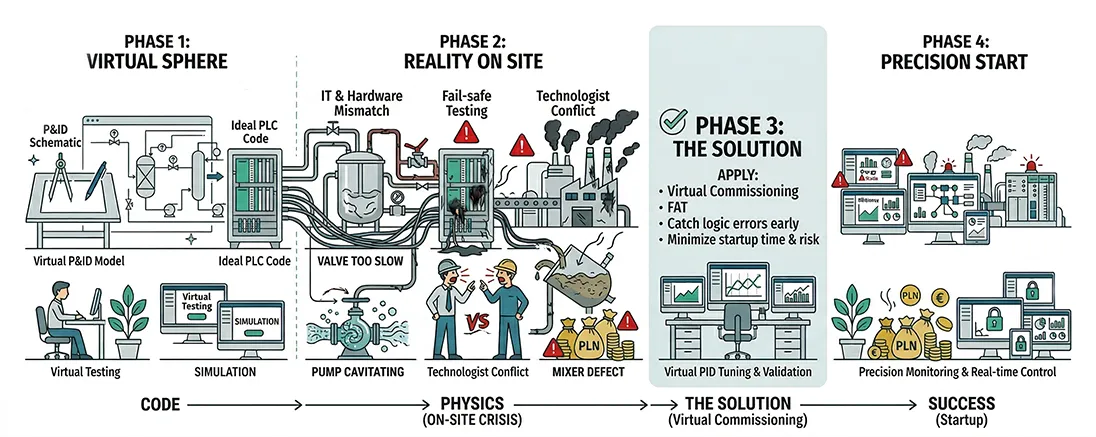
Everything works perfectly in the simulator, but at the actual plant, valves close too slowly, pumps cavitate, and mixing recipes generate defective batches. The line is at a standstill, and process engineers are arguing with automation engineers.
- IT and hardware synchronization: The PLC code does not know the viscosity of the actual product or the inertia of the motor. True commissioning means precise tuning of PID controllers and timings to the physics of the real process.
- Testing for “failure”, not “success”: Why 70% of commissioning time should be dedicated to verifying abnormal situations (loss of communication, sensor failure, E-STOP emergency stops, voltage drops), rather than the ideal operating scenario.
- Communication with process engineers: An automation engineer cannot just be the person who “spins the motors”. They must understand the chemistry and physics of the process to translate the process engineer’s requirements (e.g., “smoothly dose the reagent”) into a precise machine algorithm.
Apply Virtual Commissioning and Factory Acceptance Tests (FAT) on simulators before engineers deploy to the site. Catching logic errors in the office and conducting precise, phased live startups drastically reduces actual line downtime and minimizes the risk of machine damage.